
What to Do If Your Watch Is Lost or Stolen
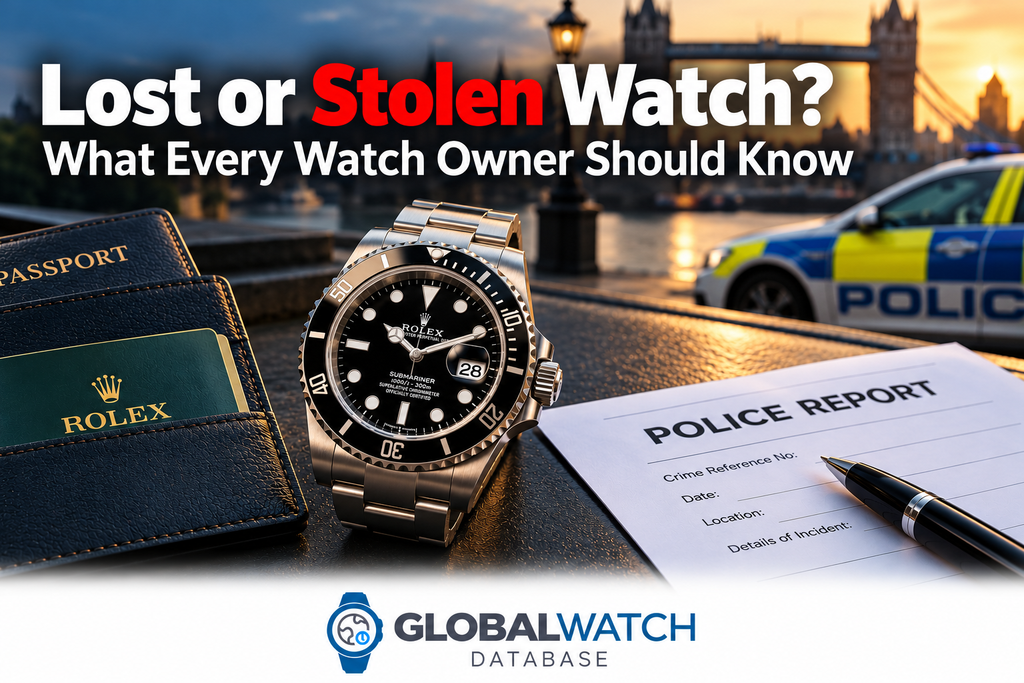
Losing a watch can be upsetting, but discovering that you have a stolen watch can be considerably worse.
A watch may have significant financial value, but for many owners its sentimental value can be even greater. It may have been purchased to mark an important occasion, inherited from a family member or owned for decades.
If a watch goes missing, acting quickly and having accurate information available can make an important difference.
Knowing the make, model, reference number and serial number of your watch, together with retaining photographs, receipts and other documentation, can help when reporting the loss or theft to the police, an insurer or a watch database.
So what should you do if your watch is lost or stolen?
1. Establish when and where the watch went missing
Before assuming that a watch has been stolen, try to establish the last time you definitely had it.
Think carefully about where the watch was worn, removed or stored.
If you were travelling, contact hotels, restaurants, airports, airlines or other locations you recently visited. If the watch disappeared from your home, vehicle or another secure location and there are signs of theft, avoid disturbing anything that could potentially be relevant to a police investigation.
Write down as much information as you can while events are still fresh in your mind.
This could include the approximate time you last saw the watch, where you were, who was present and any circumstances that appeared unusual.
2. Find your watch serial number and documentation
The serial number is one of the most important pieces of information associated with a missing watch.
Unlike a model or reference number, which may be shared by many watches of the same configuration, a serial number is intended to identify an individual watch.
Look for the watch’s:
- Make and model
- Reference number
- Serial number
- Purchase receipt or invoice
- Warranty card or certificate
- Service records
- Previous photographs
- Insurance documentation
- Details of any distinguishing marks or engravings
Police guidance illustrates why keeping this information matters. An Garda Síochána, for example, recommends recording identifying information about valuable property and its Property App allows owners to record information including the make, model, serial number and photographs.
If you don’t know where to locate your watch’s serial number, read our previous article: How to Check a Watch Serial Number Before Buying a Pre-Owned Watch.
3. Report a stolen watch to the police
If you believe the watch has been stolen rather than simply misplaced, report the theft to the relevant police authority as soon as possible.
Provide as much identifying information as you can, particularly the watch’s make, model, reference and serial number, together with photographs and supporting documentation.
For example, An Garda Síochána advises victims and witnesses to report crime as soon as possible. Its guidance also specifically identifies serial numbers and photographs as useful identifying information when property is reported.
If the theft occurred outside your home country, contact the appropriate police authority for the jurisdiction in which it occurred.
Keep a copy of any crime or incident reference number you receive. Your insurer or other organisations may subsequently ask for it.
4. Notify your insurance company
If the watch is insured, contact your insurer promptly and follow the procedure specified in your policy.
The insurer may ask for information such as proof of ownership, purchase documentation, photographs, valuations, service records, the watch serial number and the police report or crime reference number.
Do not discard documentation simply because it appears old.
Historical receipts, photographs and servicing records can help establish ownership and identify the particular watch involved.
This is another reason why watch owners should maintain an organised record of their watches before something goes wrong, rather than attempting to reconstruct that information after a theft.
5. Record the watch as lost or stolen on a watch database
Reporting a stolen watch to the police and insurer is important, but information about the watch can also be recorded with relevant watch databases.
At GlobalWatchDatabase, registered owners can maintain records associated with their watches and update a watch’s status if it becomes lost or stolen.
This creates an additional layer of information associated with the watch’s serial number.
Why does this matter?
A stolen watch may eventually re-enter the pre-owned market months or even years after the original theft.
It could potentially change hands between individuals, dealers or countries before somebody carries out a serial-number search.
Making accurate information available can therefore assist due diligence by future purchasers and businesses.
6. Keep photographs of your watch
Photographs can be extremely useful when identifying a missing watch.
Ideally, photographs should show the watch clearly from several angles, including the dial, case, bracelet or strap and any distinctive marks.
If appropriate, retain photographs of identifying information and documentation separately and securely.
Small details can sometimes distinguish one watch from another: scratches, engravings, replacement components, bracelet configuration or other characteristics acquired during ownership.
The principle is straightforward:
The easier your watch is to identify, the better the information available if it subsequently needs to be traced or verified.
7. Monitor the pre-owned market — but don’t put yourself at risk
A stolen watch may eventually appear for sale.
Owners may therefore choose to periodically monitor established pre-owned watch marketplaces, auction platforms and other appropriate sales channels.
Search using the watch’s brand, model and reference number and look carefully at photographs.
However, if you believe you have located your stolen watch, do not attempt to recover it yourself or confront the seller.
Preserve the information you have found — including the listing, seller details, photographs and URL — and provide it to the police or other appropriate authority dealing with the theft.
Personal safety should always take priority over recovering property.
8. Tell relevant dealers or service organisations where appropriate
For particularly distinctive or high-value watches, there may be circumstances in which notifying an authorised dealer, manufacturer, auction house or specialist watch business could also be appropriate.
The objective is not to distribute accusations against individuals.
It is simply to ensure that accurate identifying information about the missing watch exists in the places where it may prove useful.
Always distinguish clearly between a watch that is lost, one that is suspected stolen, and one that has formally been reported stolen.
Accurate records matter.
9. Don’t give up simply because time has passed
One of the difficulties with stolen watches is that they are portable, valuable and capable of circulating internationally.
A watch stolen in one country can potentially surface in another market much later.
Metropolitan Police data demonstrates the scale of the problem. Its published figures recorded thousands of stolen watches in London in individual years, while an earlier disclosure reported a recovery rate of just 1.8% for watches recorded as stolen in 2019.
A low immediate recovery rate does not mean that maintaining an accurate record of a stolen watch has no value.
The watch may eventually be presented for resale, servicing, insurance, authentication or purchase, creating another opportunity for its history to be questioned.
10. Prevention starts before a watch is stolen
The best time to record your watch’s information is while the watch is still safely in your possession.
Owners should consider maintaining an accurate record containing the watch’s serial and reference numbers, photographs, purchase information, valuations, service history and other relevant documentation.
Do not rely exclusively on paperwork stored alongside the watch.
If both the watch and its documentation disappear during the same burglary, reconstructing the necessary information afterwards can become much more difficult.
Secure digital records provide another means of retaining access to important watch information wherever you are.
What if you are buying a watch rather than reporting one stolen?
The responsibility for improving watch security does not rest solely with owners.
Buyers have a role too.
Before purchasing a valuable pre-owned watch, ask for the serial number and supporting documentation and carry out appropriate due diligence.
A professional-looking watch, convincing box or plausible story does not establish legitimate ownership by itself.
For more information, read our previous guide: How to Check if a Watch Is Stolen Before You Buy It.
A watch serial number can remain important for its entire lifetime
A serial number is much more than a number engraved on a watch.
It can help connect an individual watch with ownership records, documentation, insurance information, service history and lost-or-stolen records.
At GlobalWatchDatabase, our objective is to provide watch owners with tools to help manage their watches throughout the ownership journey while contributing to greater transparency and security within the international watch community.
Whether you own one watch or an extensive collection, keeping accurate records today could prove invaluable if something happens tomorrow.