
How to Check a Watch Serial Number Before Buying a Pre-Owned Watch
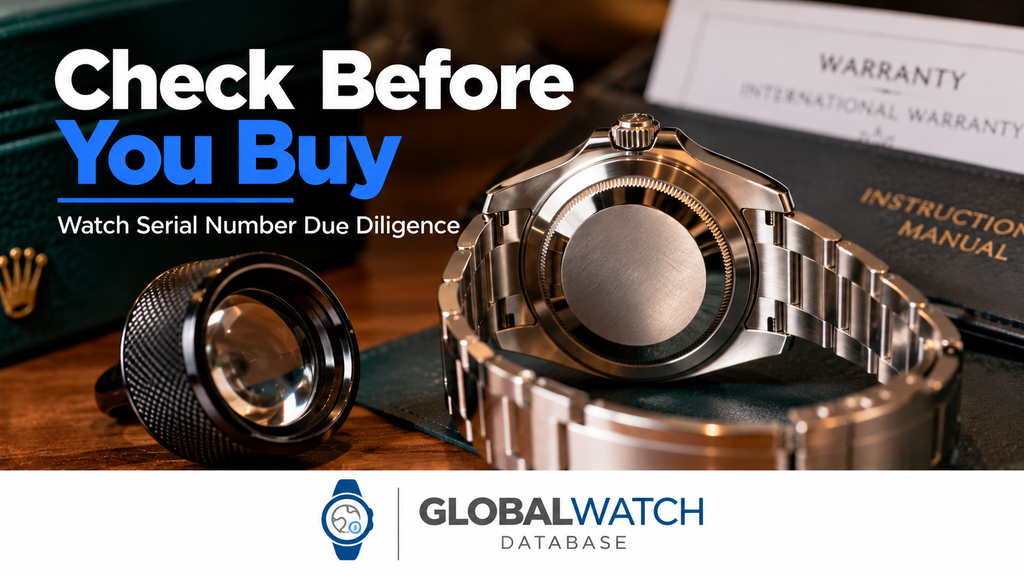
Checking a watch serial number before buying a pre-owned watch is an important part of the due-diligence process and can help you make a more informed purchase.
However, before purchasing any pre-owned watch, there is one important piece of information you should ask for: the watch serial number.
A watch serial number can help identify an individual timepiece and can be an important part of the due-diligence process. Checking the serial number, together with the watch’s documentation, ownership history and physical condition, can help a prospective buyer make a more informed decision before handing over their money.
But what exactly should you check?
What is a watch serial number?
A watch serial number is a unique identifying number assigned to an individual watch by its manufacturer.
It should not be confused with the model or reference number.
A reference number normally identifies a particular model or configuration, meaning numerous watches may share the same reference. A serial number, on the other hand, is intended to identify an individual watch.
Think of the reference number as identifying what the watch is, while the serial number helps identify which individual watch it is.
This makes the serial number particularly important when buying, selling, insuring, registering or reporting a watch as lost or stolen.
Where can I find the serial number on a watch?
The location of a serial number varies depending on the manufacturer, model and age of the watch.
Depending on the watch, identifying information may be engraved on the case, positioned between the lugs, located on the caseback or found elsewhere on the watch. It may also appear on original warranty cards, certificates, sales documentation or service records.
If you are unsure where the serial number should be located, consult information from the manufacturer or an authorised retailer/service centre for that particular brand.
Be cautious about relying solely on photographs of paperwork. Ideally, identifying information associated with the watch should be checked against the physical timepiece wherever practicable.
Why should you check a watch serial number?
The pre-owned watch market operates internationally. A watch can change hands multiple times and potentially travel through several countries during its lifetime.
Unfortunately, lost and stolen watches can also re-enter the secondary market.
The Metropolitan Police for example, publishes data on reported watch thefts in London, highlighting the prevalence of watch theft and the importance of carrying out appropriate checks when purchasing a valuable pre-owned watch.
A buyer may have no reason to suspect there is anything wrong with a watch simply by looking at it.
The seller may appear genuine.
The watch may have a box.
It may have papers.
It may even have changed ownership several times since the original loss or theft occurred.
That is why the serial number can form an important part of a buyer’s due diligence.
How to check a watch serial number
Before buying a pre-owned watch, consider taking the following steps.
1. Ask the seller for the serial number
Ask for the watch’s identifying information before completing the transaction.
If a seller refuses to provide sufficient information for you to perform reasonable checks, you can decide whether you are comfortable proceeding with the purchase.
For particularly valuable watches, the more information available to establish the watch’s history, the better.
2. Compare the serial number with the documentation
Where documentation is supplied with the watch, check whether the identifying numbers correspond with the timepiece being offered.
Look at items such as:
- Warranty or guarantee cards
- Original purchase receipts
- Service documentation
- Manufacturer or authorised dealer records where available
- Previous sales documentation
An inconsistency does not automatically prove that a watch is stolen or counterfeit, particularly with vintage watches where paperwork may have been lost or replaced. However, unexplained discrepancies deserve further investigation.
3. Search the serial number against available watch databases
The next step is to determine whether the watch has been recorded on relevant watch databases.
GlobalWatchDatabase allows registered watches to be associated with their make, model and serial number, and owners can update the status of a registered watch if it is subsequently lost or stolen. A prospective purchaser can therefore use available database information as another layer of due diligence.
Importantly, no single database should be assumed to contain every lost or stolen watch worldwide.
A search returning no adverse record should therefore not be interpreted as an absolute guarantee that a watch has never been lost or stolen.
Instead, database searches should form one part of a broader checking process.
4. Check the seller as well as the watch
Due diligence should not stop with the serial number.
Consider who is actually selling the watch.
If you are purchasing from a professional dealer, investigate the business, its history, physical location, customer reviews and returns policy.
For a private transaction, consider whether the seller can provide a credible explanation of the watch’s ownership and supporting documentation.
Be particularly careful if you are being pressured to complete a high-value transaction quickly.
5. Remember that a serial-number check is not authentication
This distinction is extremely important.
A watch serial-number search and a professional authentication are not the same thing.
A database may help identify information associated with a serial number or indicate that a watch has been recorded as lost or stolen. That does not necessarily establish whether every component of the physical watch is genuine.
Authentication may require specialist examination of the watch, its movement, case, dial, bracelet and other components.
For example, Rolex states that its Official Rolex Retailers have the expertise and equipment required to guarantee the authenticity of each part of a Rolex presented through its official network.
For a high-value purchase, professional authentication and serial-number/database checks can therefore serve different purposes.
What if the serial number has been removed or altered?
A missing, damaged or apparently altered serial number should be treated seriously.
There may occasionally be legitimate explanations for unusual markings on an older watch, including historic repairs, replacement components or previous servicing.
However, if an identifying number appears deliberately removed, altered or inconsistent with the accompanying documentation, do not simply ignore it.
Seek advice from an appropriate manufacturer, authorised service centre or suitably qualified watch professional before proceeding.
What if the watch comes with box and papers?
Original box and papers can add useful provenance, but their presence should not replace independent checks.
Documents and accessories can become separated from watches over time, and paperwork itself should be examined as part of the overall transaction.
The important question is not simply:
“Does this watch have papers?”
It is:
“Do the watch, serial number, documentation, seller and ownership history make sense together?”
That is a much stronger approach to buying pre-owned.
Registering your own watch serial number
Serial numbers are not only important when buying a watch.
Owners should also maintain an accurate record of the serial numbers of watches they already own.
GlobalWatchDatabase enables owners to create a private digital record for their watches, including information such as the make, model and serial number, together with photographs, documentation and other records. If a registered watch is subsequently lost or stolen, its status can be updated accordingly.
Maintaining these records before something happens can be considerably easier than trying to locate serial numbers, receipts and photographs after a watch has disappeared.
The bottom line
A watch serial number is one of the most important pieces of identifying information attached to a timepiece.
Before purchasing a pre-owned watch:
Check the serial number. Check the documentation. Check available databases. Check the seller. And, where appropriate, have the watch professionally authenticated.
No individual check can eliminate every risk associated with purchasing a pre-owned watch.
However, combining these steps can give buyers considerably more information on which to base their purchasing decision.
For further guidance, read our previous article: How to Check if a Watch Is Stolen Before You Buy It.
And before purchasing a pre-owned watch, you can carry out a watch search through GlobalWatchDatabase.
Sensible watch ownership starts with GlobalWatchDatabase.com