
How to Check if a Watch Is Stolen Before You Buy It
If you want to check if a watch is stolen before buying it, there are several important steps you can take. Buying a pre-owned watch can be an excellent way to find a discontinued model, vintage timepiece or simply a watch at a more attractive price than buying new.
However, there is one question every prospective buyer should consider before handing over their money:
Could this watch have been reported lost or stolen?
A watch can be completely genuine and still have a problematic history. Authentication and ownership history are therefore two different considerations when purchasing a pre-owned watch.
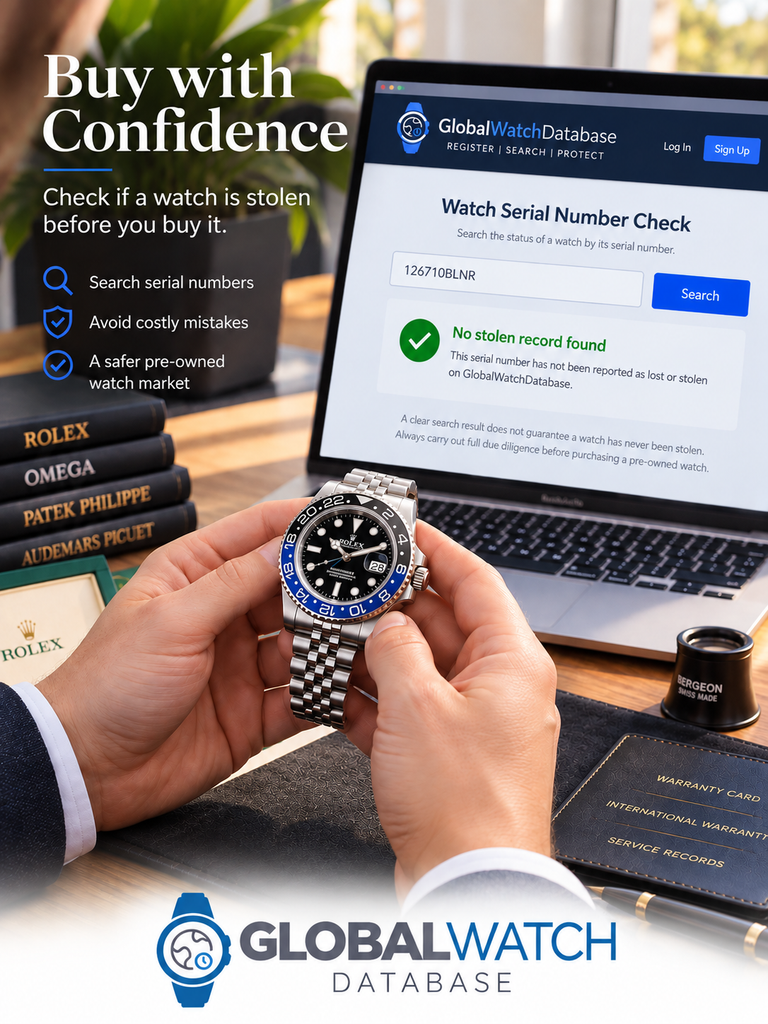
Start with the watch’s serial number
One of the most important pieces of information associated with a watch is its serial number.
While a model or reference number generally identifies a particular type of watch, the serial number is intended to identify the individual watch.
Before purchasing a pre-owned watch, ask the seller for the serial number and check that it corresponds with the watch and any accompanying documentation.
Depending on the manufacturer and model, the serial number may be found on the case, caseback, between the lugs, on the rehaut or within the watch’s original documentation.
If you are uncertain where the serial number should appear, an authorised dealer or experienced watchmaker may be able to assist.
Search lost and stolen watch databases
Once you have the serial number, it can be searched against watch databases.
GlobalWatchDatabase allows prospective purchasers and other interested parties to search watch serial numbers and determine whether a corresponding watch has been recorded on our database as lost or stolen.
Other established databases also operate within the watch industry, and checking more than one source can provide an additional layer of due diligence. The Watch Register, for example, provides serial-number searches against its database of lost and stolen watches.
It is important, however, to understand the limitation of any database search.
A search showing no lost or stolen record does not guarantee that a watch has never been stolen.
A database can only identify records contained within the information available to it. A theft may never have been reported, or the watch may have been recorded elsewhere.
A database search should therefore form part of the purchasing process rather than being treated as an absolute guarantee.
Check the watch against its paperwork
If the watch comes with its original box, warranty card, purchase receipt, service records or other documentation, examine these carefully.
Check whether the serial and reference numbers correspond with the watch itself.
Documentation can provide useful information about a watch’s history, but buyers should not rely solely upon the presence of “box and papers.” The Watch Register, for example, recommends stolen-watch checks even where a pre-owned watch is accompanied by box and papers.
Research the seller
The watch is only one part of the transaction. The seller matters too.
When purchasing from a business, research its history, reputation and physical presence.
For a private transaction, consider whether the seller can reasonably demonstrate ownership of the watch.
Be cautious if a seller refuses to provide information that would normally be expected for a high-value transaction, particularly when purchasing an expensive luxury watch.
Be cautious about unusually low prices
Everybody likes a bargain, but an unusually attractive price deserves additional scrutiny.
Compare the asking price with similar watches currently available through reputable dealers and marketplaces.
A low price does not necessarily mean that something is wrong, but a significant difference should encourage you to investigate the watch and seller more carefully before proceeding.
Authentication and stolen-watch checks are different
This distinction is particularly important.
Authentication asks: Is the watch genuine?
A lost or stolen watch search asks: Has information matching this watch been recorded as lost or stolen?
A genuine Rolex, Omega, Breitling, Patek Philippe or other watch can still have been stolen.
Conversely, finding no stolen record does not authenticate the watch.
For a significant purchase, buyers should consider both provenance checks and professional authentication.
What happens if a database finds a match?
If a serial-number search produces information indicating that the watch may have been recorded as lost or stolen, do not proceed with the purchase until the situation has been properly investigated.
Watch theft remains a significant issue: Metropolitan Police data has documented thousands of stolen watches in London, with historically low recovery rates.
A database match should be verified carefully because information may require confirmation and circumstances can vary.
Contact the database concerned and, where appropriate, seek guidance from the relevant law-enforcement authority or other appropriate party.
Do not attempt to recover a suspected stolen watch yourself.
What if the search comes back clear?
A clear database search is useful information, but it should not be interpreted as proof of clean ownership history.
Consider the complete picture:
Does the serial number correspond with the watch?
Does the documentation make sense?
Is the seller credible?
Does the price appear reasonable?
Has the watch been professionally authenticated where appropriate?
Have relevant lost and stolen watch databases been searched?
The more valuable the watch, the stronger the case for carrying out comprehensive due diligence before completing the transaction.
How to check if a watch is stolen before you buy
The pre-owned watch market allows watches to change owners, dealers and even countries many times during their lifetime.
The history of a watch therefore matters.
Taking a few minutes to check if a watch is stolen and investigate its serial number before purchasing can provide another valuable layer of information about the watch you are considering.
Before purchasing a pre-owned watch, search its serial number on GlobalWatchDatabase and check whether it has been recorded on our database as lost or stolen.
And if you already own watches, registering them and securely recording their identifying information can make that information considerably easier to access should a watch ever be lost or stolen.