
What Happens to Your Watch Collection When You Die? A Guide to Inheritance, Ownership and Documentation
Watch collection inheritance is something many collectors rarely consider. You’ve spent years building your collection, but if something happened to you tomorrow, would your family know exactly what you own, what your watches are worth, or where to find the paperwork?
For many watch enthusiasts, collecting is a lifelong passion. A collection might begin with a relatively inexpensive watch purchased to celebrate a personal achievement and gradually develop into something considerably more valuable.
Over time, collectors may acquire watches from Rolex, Omega, Breitling, Tudor, Patek Philippe, Audemars Piguet, Richard Mille and numerous other manufacturers.
Each watch can carry its own story, financial value and sentimental significance.
But there is one important question that many collectors rarely consider:
What happens to your watch collection when you die?
Unlike money held in a bank account or property registered in an owner’s name, a watch collection may consist of individual possessions acquired over several decades, with documentation scattered across different locations.
Without accurate records, the people inheriting those watches could face unexpected difficulties.
In this article, we explore what happens to a watch collection after its owner’s death, why ownership documentation matters, the challenges of valuing inherited watches and how collectors can prepare their collections for the next generation.
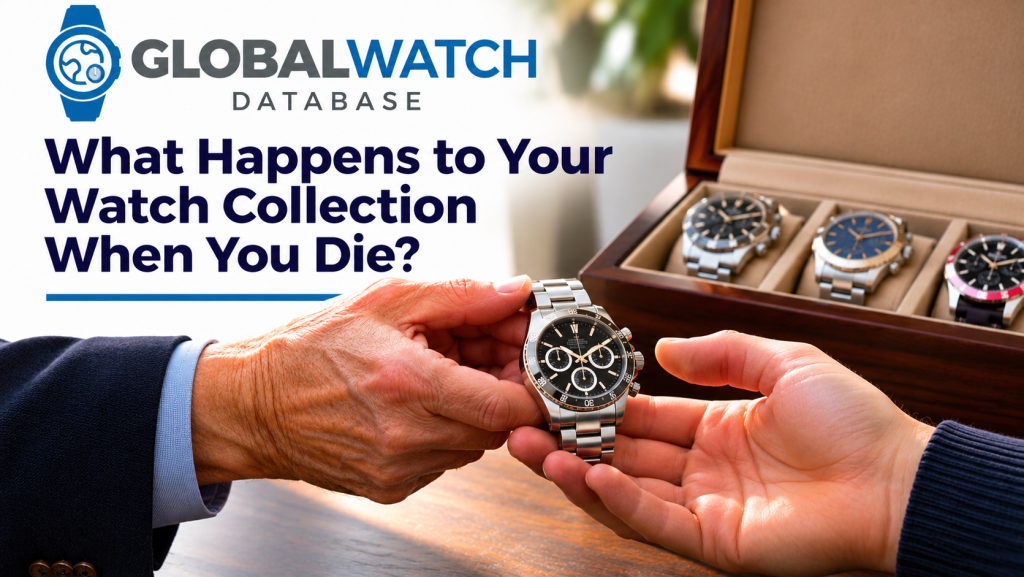
What Happens to Your Watches When You Die?
When a watch owner dies, their watches generally form part of their estate, unless a particular watch is legally owned by someone else or is subject to another arrangement.
An estate includes the assets, property and possessions belonging to the deceased person.
Depending on the circumstances, a watch collection may pass to a surviving spouse, children, other family members or beneficiaries named in a will.
The process of transferring ownership is governed by the inheritance and succession laws applicable to the estate.
For example, a collector might leave a particular Rolex to one child, an Omega to another and the remainder of their collection to their spouse.
Alternatively, the collection may be sold, with the proceeds distributed among beneficiaries.
However, difficulties can arise when a collector has not left clear instructions or when the watches themselves cannot be properly identified.
A watch collection may be financially valuable, but without adequate documentation, managing its inheritance can become unnecessarily complicated.
Does Your Family Know What Watches You Own?
Consider a hypothetical collector who has spent 30 years purchasing watches.
During that time, they have acquired 15 watches from several different manufacturers.
Some were purchased new from authorised dealers. Others were bought pre-owned through online marketplaces, private sellers or specialist retailers.
The collector understands the history of every watch.
They know which watches have their original boxes and papers, which have been serviced, which are insured and which were purchased at particularly favourable prices.
But does anyone else know?
Their family might recognise a Rolex Submariner or an Omega Speedmaster, but they may have little knowledge of the remaining watches.
They may not know:
- How many watches are in the collection.
- The brand, model and serial number of each watch.
- Where each watch was purchased.
- Whether original receipts and warranty cards still exist.
- Which watches have been serviced or repaired.
- Whether individual watches are insured.
- Which watches have significant financial or sentimental value.
This information can be extremely useful when identifying, valuing, distributing or selling inherited watches.
Without it, family members may have to reconstruct the collection’s history themselves.
Why Watch Documentation Matters When Inheriting a Collection
A luxury watch is more than an attractive object.
It is an individually identifiable possession, often with a unique serial number, purchase history and supporting documentation.
For collectors, these details help establish a record of the watch and its history.
For beneficiaries, they can also help answer important questions about an inherited watch.
1. Identifying the Correct Watch
Many watch manufacturers produce several variations of the same model.
Two watches may look remarkably similar while having different reference numbers, production dates, materials or specifications.
These differences can significantly influence their market values.
Recording the manufacturer, model, reference number and serial number helps distinguish one watch from another.
2. Establishing Ownership History
Purchase receipts, invoices, warranty cards and other documentation can provide valuable evidence of a watch’s acquisition and history.
They may also help an executor or beneficiary understand where and when a watch was purchased.
However, it is important to distinguish between evidence of purchase and legal ownership.
A receipt or database registration can support an ownership history, but neither necessarily establishes legal title on its own.
The legal transfer of an inherited watch depends on the applicable estate and succession arrangements.
3. Understanding Servicing and Maintenance
Luxury mechanical watches may require periodic servicing and maintenance.
Service records can help beneficiaries understand a watch’s condition, previous repairs and maintenance history.
This information can also be useful if the watch is eventually sold.
4. Supporting Insurance and Valuation
Accurate records may assist insurers, valuers and estate representatives when identifying watches and assessing their values.
A detailed inventory can reduce uncertainty and make the process more manageable.
How Much Is an Inherited Watch Collection Worth?
One of the most difficult questions facing beneficiaries is determining the value of an inherited watch collection.
The original purchase price does not necessarily reflect what a watch is worth today.
Some watches appreciate in value. Others depreciate.
Market demand, brand reputation, condition, rarity, provenance and the availability of original accessories can all influence a watch’s resale value.
For example, a collector may have purchased a particular watch many years ago for considerably less than its current market value.
Conversely, another watch may now be worth substantially less than its original retail price.
This creates an important distinction between three different figures:
Original purchase price: The amount paid when the watch was acquired.
Current market value: An estimate of what the watch might achieve in the prevailing market.
Insurance replacement value: The amount an insurer may use to assess the cost of replacing a watch under a particular policy.
These figures are not necessarily interchangeable.
For inheritance and estate administration, the relevant valuation basis will depend on local law and the circumstances of the estate.
Where a collection contains valuable watches, obtaining an independent professional valuation may be advisable.
What Happens If a Watch Has No Box or Papers?
Many collectors place considerable importance on original boxes, warranty cards and purchase documentation.
These items can support a watch’s provenance and may affect its desirability in the pre-owned market.
But what happens when a watch is inherited without its original paperwork?
The absence of a box or papers does not automatically mean a watch is stolen, counterfeit or illegally owned.
Genuine watches frequently change hands without their original accessories.
However, missing documentation can make it more difficult to establish the watch’s history.
For beneficiaries unfamiliar with luxury watches, this can create additional uncertainty.
Photographs, recorded serial numbers, purchase details and servicing documentation can all help preserve useful information about a watch, even when its original paperwork is no longer available.
This is one reason why maintaining a digital record during the owner’s lifetime can be beneficial.
Can Inherited Watches Be Sold?
Yes. Inherited watches can generally be sold once the person selling them has the legal authority to do so.
However, beneficiaries and estate representatives should first establish that the watches can lawfully be transferred or sold.
Depending on the jurisdiction and stage of estate administration, this may require involvement from an executor, administrator or other authorised representative.
Once ownership and authority to sell are established, inherited watches may be offered through specialist watch dealers, auction houses, online marketplaces or private sales.
Before selling, it is sensible to:
- Identify each watch accurately.
- Obtain an appropriate valuation.
- Gather available ownership and servicing documentation.
- Check the watch’s serial number against relevant lost and stolen watch records.
- Understand any fees or commissions involved in the sale.
- Keep records of the transaction.
Buyers of pre-owned watches may also request information about provenance and ownership history.
A well-documented watch can therefore be easier to explain to prospective purchasers than one with little or no recorded history.
Could Your Family Accidentally Sell a Valuable Watch Too Cheaply?
Imagine inheriting a collection of watches without knowing much about the brands or models involved.
Some watches may be immediately recognisable.
Others may appear relatively ordinary.
A watch that looks unremarkable to someone unfamiliar with the industry could potentially have considerable value because of its rarity, reference number, historical significance or market demand.
Without accurate identification and professional advice, beneficiaries risk making decisions based on incomplete information.
This does not mean every inherited watch is valuable.
It means that every watch should be properly identified before decisions are made about its future.
A detailed inventory gives beneficiaries a starting point for researching individual watches and seeking appropriate valuations.
What About Inheritance Tax on Luxury Watches?
Depending on the country, the value of inherited watches may need to be considered when calculating inheritance or estate taxes.
Different jurisdictions have different rules governing exemptions, thresholds, valuation dates and reporting requirements.
For example, Ireland has Capital Acquisitions Tax rules that may apply to inheritances, while the United Kingdom operates under a different inheritance tax framework.
The treatment of an inherited watch collection will depend on factors including the relevant jurisdiction, the estate’s circumstances and the relationship between the deceased person and the beneficiary.
Because tax rules and thresholds can change, beneficiaries should consult current official guidance or obtain professional advice.
A watch collection should not be assumed to be exempt from inheritance or estate taxes simply because it consists of personal possessions.
Watch Collection Inheritance: How to Prepare for the Next Generation
Preparing a watch collection for inheritance does not need to be complicated.
The most important starting point is ensuring that accurate information exists and can be located by the appropriate people when needed.
Create a Complete Watch Inventory
List every watch in your collection, including its brand, model, reference number and serial number.
This gives your family or estate representative a clear record of the watches you own.
Preserve Important Documentation
Keep copies of purchase receipts, warranty cards, servicing records, photographs and other relevant information.
Where possible, retain original documentation securely.
Review Your Collection Periodically
Collections change over time.
Watches may be purchased, sold, gifted, serviced or replaced.
Keeping your records up to date helps ensure that an inventory remains useful.
Consider Professional Valuations
For particularly valuable watches, professional valuations can provide useful information for insurance and estate-planning purposes.
These should be reviewed when circumstances or market conditions justify it.
Discuss Your Wishes With Your Family
If certain watches have particular sentimental significance, consider discussing your wishes with the people who may eventually inherit them.
For example, a watch purchased to celebrate a wedding anniversary may hold a different kind of value from one acquired primarily as a collectible.
Where appropriate, these wishes should also be reflected in properly prepared legal estate-planning documents.
How GlobalWatchDatabase Can Help You Document Your Collection
At GlobalWatchDatabase.com, we believe sensible watch ownership involves more than protecting against theft.
It also involves maintaining accurate, accessible records of the watches you own.
GlobalWatchDatabase allows registered users to create a private account and maintain a digital record of their watch collections.
Owners can record important information, including:
- Watch brands, models and serial numbers.
- Photographs of individual watches.
- Purchase receipts and supporting documentation.
- Servicing information and maintenance history.
- Warranty details and important dates.
- Additional notes relevant to individual watches.
This allows owners to organise important watch information in one place rather than relying entirely on paperwork stored in different locations.
Accounts are private, and users can register without publicly disclosing their identities.
For collectors who own multiple watches, this can provide a practical way to maintain an organised inventory throughout their ownership.
However, there is an important distinction to understand.
GlobalWatchDatabase is a watch-management and security platform. It is not a will, an inheritance service or a legal register that determines who owns a watch.
Registering a watch does not automatically transfer legal ownership to a beneficiary.
Likewise, a private GlobalWatchDatabase account does not automatically become accessible to family members or executors after the account holder’s death.
Collectors should therefore make appropriate arrangements through their estate-planning process so authorised representatives know that relevant watch records exist and understand how to deal with them lawfully.
A Watch Collection Is More Than Its Financial Value
For many collectors, watches represent important moments in their lives.
A first luxury watch might commemorate a career achievement.
Another might have been a wedding gift.
A particular timepiece could have belonged to a parent or grandparent before being passed down through generations.
While financial valuations are important, they do not capture the personal significance attached to these possessions.
Unfortunately, stories and ownership histories can disappear when they are never recorded.
A well-maintained collection inventory can help preserve some of that information for future generations.
It can also make practical matters considerably easier for the people responsible for managing a collection after its owner’s death.
Final Thoughts: Don’t Leave Your Watch Collection’s History to Chance
Building a watch collection can take decades.
Each purchase may involve careful research, considerable expense and personal significance.
Yet the information associated with those watches is often far less organised than the collection itself.
If something happened to you tomorrow, would your family know exactly which watches you own?
Would they understand their approximate values?
Would they know where to find the receipts, serial numbers, servicing records and other important documentation?
And would they know which watches you hoped to pass on to particular people?
These are questions worth considering while you still have the opportunity to answer them.
You cannot always predict what will happen to your watch collection in the future. But you can take sensible steps today to preserve its information, history and documentation.
GlobalWatchDatabase.com provides watch owners and collectors with a private platform for recording and managing their watches.
Because sensible watch ownership isn’t just about the watches you own today.
It’s also about preserving the information that may matter tomorrow.
Sensible watch ownership starts with GlobalWatchDatabase.com.