
Watch Insurance Gaps Costing Insurers Millions
The value of the watch market
In 2025, the global watch market was valued at approximately $75.8 billion, comprising:
New watches: $59.1 billion – 78%
Pre-owned watches: $16.7 billion – 22%
Source: Watches of Switzerland Group, Strategy Deep Dive presentation, July 2026.
The pre-owned watch market is an increasingly important part of the wider watch industry. Rolex itself entered the certified pre-owned market, providing customers with the opportunity to purchase pre-owned Rolex watches that have been authenticated by the brand and are sold with a two-year international guarantee.
As the secondary market grows, however, there is another issue that deserves considerably more attention: insurance and the history of the watches being insured.
The watch insurance problem
Many watch owners assume that their watches are automatically and fully covered under a standard home insurance policy. Depending on the insurer, policy and value of the watch, this may not be the case. High-value watches can require specific declaration, valuation or additional cover.
There is another complication: watch values change.
If a watch was insured several years ago, does its current insured value accurately reflect today’s replacement value? Owners of valuable watches should regularly review their valuations and insurance cover.
Then there is theft.
Recovery rates for stolen watches can be extremely low. Metropolitan Police data reported that just 59 of 5,180 high-value watches (£3,000+) stolen in London between January 2022 and July 2025 were recovered, approximately one in 88.
High-value watches are also extremely portable. A watch stolen in one country can potentially be transported and subsequently sold in another, creating an international problem for owners, insurers, dealers and prospective buyers.
The pre-owned market creates another challenge
A significant proportion of pre-owned watches are offered without their original box and papers. Chrono24 has previously reported that listings with box and papers outnumber watch-only listings by roughly two to one.
Buying without the original documentation does not necessarily mean there is anything wrong with a watch, but it makes independent due diligence particularly important.
Consider this scenario.
Someone purchases a pre-owned watch without its original paperwork. They don’t insure it and haven’t separately recorded its serial number.
The watch is subsequently stolen.
Without the serial number readily available, reporting and identifying that particular watch becomes considerably more difficult.
The watch may then change hands several times before eventually being purchased by someone who has absolutely no idea that it was previously stolen.
That new owner subsequently decides to insure it.
The insurer may not know its history. The new owner may not know its history. Yet a previously stolen watch could potentially have re-entered the legitimate market and subsequently be presented for insurance.
So what should buyers be asking?
If you purchase a pre-owned watch, do you request its serial number before completing the transaction so that you can check available watch databases?
Do all online watch marketplaces require the complete serial number to be publicly displayed in sellers’ advertisements so prospective purchasers can independently check watch databases?
And what happens if the watch you’re considering purchasing was previously the subject of a theft-related insurance claim?
These questions become increasingly important as the pre-owned market grows.
The underlying problem is fragmentation
A stolen watch may be recorded with one insurer, one police force or one watch database, but not another.
Years later, that same watch could potentially re-enter the legitimate pre-owned market and be purchased by someone with no knowledge of its previous history.
That purchaser might then seek insurance from an entirely different insurance company.
This raises some important questions:
Are all insurance companies working with every credible watch database? No.
Are all stolen watches recorded across every stolen-watch database? No.
Do all insurers require confirmation that a pre-owned watch has been independently verified or authenticated? No.
Is there a single universal system through which every insurer can cross-reference watch serial numbers and theft records worldwide? No.
That fragmentation creates gaps through which information can potentially be lost.
Connecting the watch industry
This is one of the problems GlobalWatchDatabase is working to address.
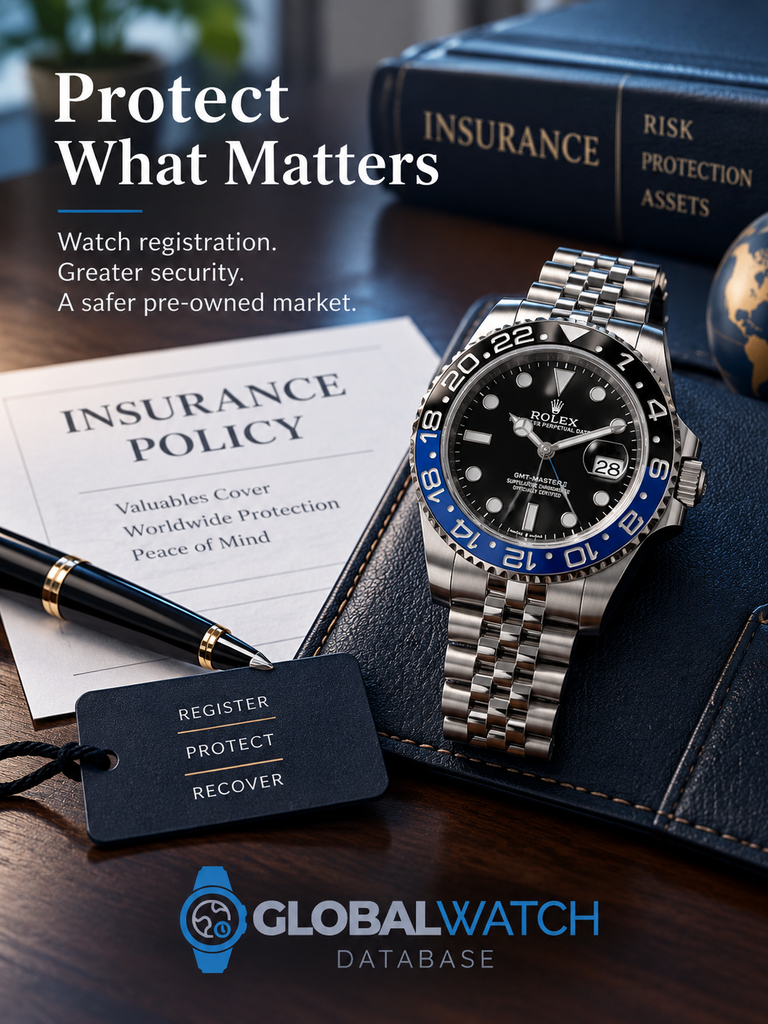
GlobalWatchDatabase provides watch owners with a permanent digital record of their watch and its serial number, together with the ability to securely store photographs, documentation, purchase information and other important records.
If a registered watch is subsequently lost or stolen, its status can be updated accordingly. Its serial number can then be checked through GlobalWatchDatabase, helping prospective purchasers and other interested parties identify a watch that has been recorded as lost or stolen.
Better information sharing between watch owners, insurers, law enforcement, dealers, marketplaces, manufacturers and watch databases has the potential to make it considerably more difficult for stolen watches to re-enter the legitimate market unnoticed.
The global pre-owned watch market is growing.
The systems used to protect owners, buyers and insurers need to evolve with it.
Register your watch with GlobalWatchDatabase today for added security as well as having access to your private watch information in real time, regardless of where you have stored your watch paperwork.
Note: Where an insurer has already settled a claim for a stolen watch that is subsequently recovered, rights to the recovered watch may pass to the insurer depending on the terms of the insurance policy and applicable law. Policyholders should contact their insurer before taking any action involving a recovered watch.